
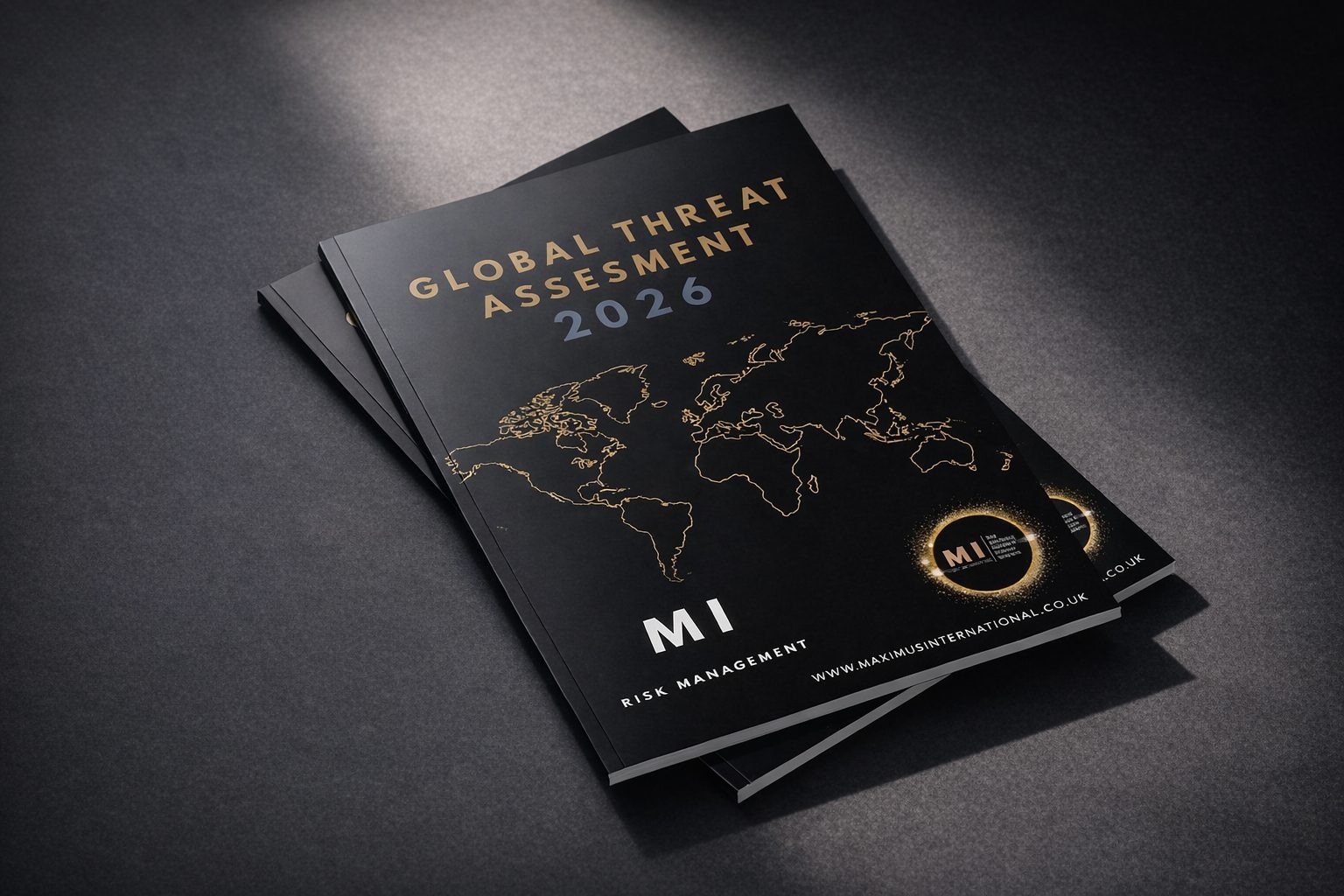
Global Threat Assessment 2026
A strategic overview of the threats shaping business, wealth, travel and personal security in a more competitive and less predictable world.
The global operating environment in 2026 is defined by greater competition, weaker predictability and faster escalation. For ultra high net worth individuals, family offices, corporates and legal advisers, risk is no longer confined to one jurisdiction or one discipline. Geopolitical tension, economic pressure, cyber intrusion, hostile information activity and climate disruption now interact in real time.
At Maximus International, we assess risk through an operational lens. We focus on what matters most to decision makers, where exposure is rising, how quickly conditions can deteriorate and what practical measures reduce vulnerability.
This Global Threat Assessment 2026 highlights the most important global risks of the year and the implications for clients operating across borders.
Geoeconomic confrontation
Trade pressure, sanctions, strategic export controls, investment restrictions and competition over critical technologies are reshaping the commercial landscape. What was once a compliance issue has become a board level security issue.
For clients, this means increased exposure to disrupted transactions, enhanced diligence requirements, higher regulatory scrutiny, restricted counterparties and sudden market dislocation. Cross border deals can stall without warning, supply routes can become politically exposed, counterparty risk can rise quickly and market access can narrow with little notice.
Armed conflict and regional escalation
State based conflict remains one of the defining risks of 2026. Even where clients are not operating in a war zone, conflict can alter aviation routes, maritime security, fuel pricing, insurance costs, sanctions enforcement and executive travel planning.
The practical issue is not only direct threat. It is also the second and third order effect of instability spreading through trade corridors, political alliances and critical infrastructure. Executive travel now requires deeper pre trip intelligence, evacuation and contingency planning have become more important, physical security postures need regular review and exposure can increase in countries previously considered low concern.
Cyber intrusion and AI enabled threat activity
Cyber risk is now inseparable from geopolitical and commercial risk. Organisations face a rising threat from ransomware, fraud, software exploitation, supply chain compromise and AI enabled social engineering.
For private clients and businesses alike, the greatest danger is often blended risk. A cyber incident can trigger financial loss, reputational damage, operational disruption and personal safety concerns at the same time. Senior individuals are more exposed to impersonation and targeted fraud, third party technology dependencies create hidden vulnerabilities, a cyber event can quickly become a legal and reputational crisis and digital due diligence is now part of protective security.
Misinformation, disinformation and reputational attack
False narratives, manipulated content and coordinated online amplification can damage trust, distort decision making and create security concerns. In 2026, disinformation is not just a political problem. It is a business, legal and personal risk.
This is particularly relevant for public figures, founders, litigants, family offices and brands operating in contested sectors or sensitive jurisdictions. Reputational attacks can escalate quickly across platforms, deeper due diligence is needed before disputes and transactions, crisis communications must align with intelligence and legal strategy and monitoring hostile narrative activity is now a protective measure.
Economic slowdown, debt pressure and financial volatility
The global economy remains vulnerable to slower growth, persistent uncertainty, fiscal strain and abrupt repricing across markets. Higher financing costs, policy unpredictability and weaker institutional confidence can all increase stress on companies, investors and cross border operations.
For clients, periods of financial volatility often reveal hidden weaknesses in counterparties, security providers, logistics chains and local operating partners. Solvency and counterparty checks become more important, distress can increase fraud and insider threat risk, asset protection and recovery planning gain importance and security and resilience budgets must be spent with precision.
Extreme weather and climate disruption
Environmental risk remains a material operational threat. Extreme weather, heat, wildfire, flooding and infrastructure disruption can affect travel, property, logistics, site security and continuity planning.
For international clients, climate related disruption should be treated as a live operational issue rather than a distant policy concern. Itineraries need climate aware route planning, physical sites need resilience and business continuity review, critical infrastructure failure can disrupt secure movements and insurance assumptions may not match real world exposure.
Supply chain and critical infrastructure vulnerability
Ports, energy systems, telecoms, cloud providers, transport networks and data infrastructure all sit under growing pressure. In a fragmented world, disruption in one area can quickly affect another.
The core issue is dependency. Many organisations do not fully understand where their critical exposures sit until disruption has already started. Single points of failure need to be identified early, protective planning must include suppliers and service partners, contingency options should be in place before disruption occurs and critical infrastructure risk now affects both physical and digital operations.
Civil unrest, political instability and weak governance
Political grievance, inequality, contested elections, weak institutions and localised unrest continue to affect operating conditions in many regions. For businesses and private clients, the threat is often one of volatility rather than permanence.
A location may appear calm until a trigger event changes the picture quickly. Local intelligence matters more than broad country labels, movement planning should be updated more frequently, venue security and route security require active review and legal, regulatory and enforcement risk may shift quickly.
Why this matters for our clients
For our clients, risk is rarely theoretical. It affects travel, residency, transactions, executive exposure, family security, reputation and the ability to act with confidence.
The challenge in 2026 is not simply that there are more threats. It is that risks are now interconnected. A geopolitical event can trigger cyber aggression. A climate event can expose infrastructure weakness. A financial shock can increase fraud, theft, protest activity and hostile opportunism.
That is why effective risk management must combine intelligence, investigation, protection and operational planning.
How Maximus International responds
We support clients with, intelligence led solutions designed for real world decisions.
Our work includes global threat and vulnerability assessments, executive and family risk reviews, travel risk and route analysis, protective intelligence and hostile actor monitoring, due diligence and investigative support, crisis planning and response preparation, and security reviews for property, movement and key personnel.
We do not offer generic commentary. We provide tailored insight and practical recommendations grounded in operational reality.
Need a confidential assessment of your exposure in 2026?
Maximus International provides support to private clients, family offices, corporate principals and legal advisers who require clear judgement in complex environments.


