
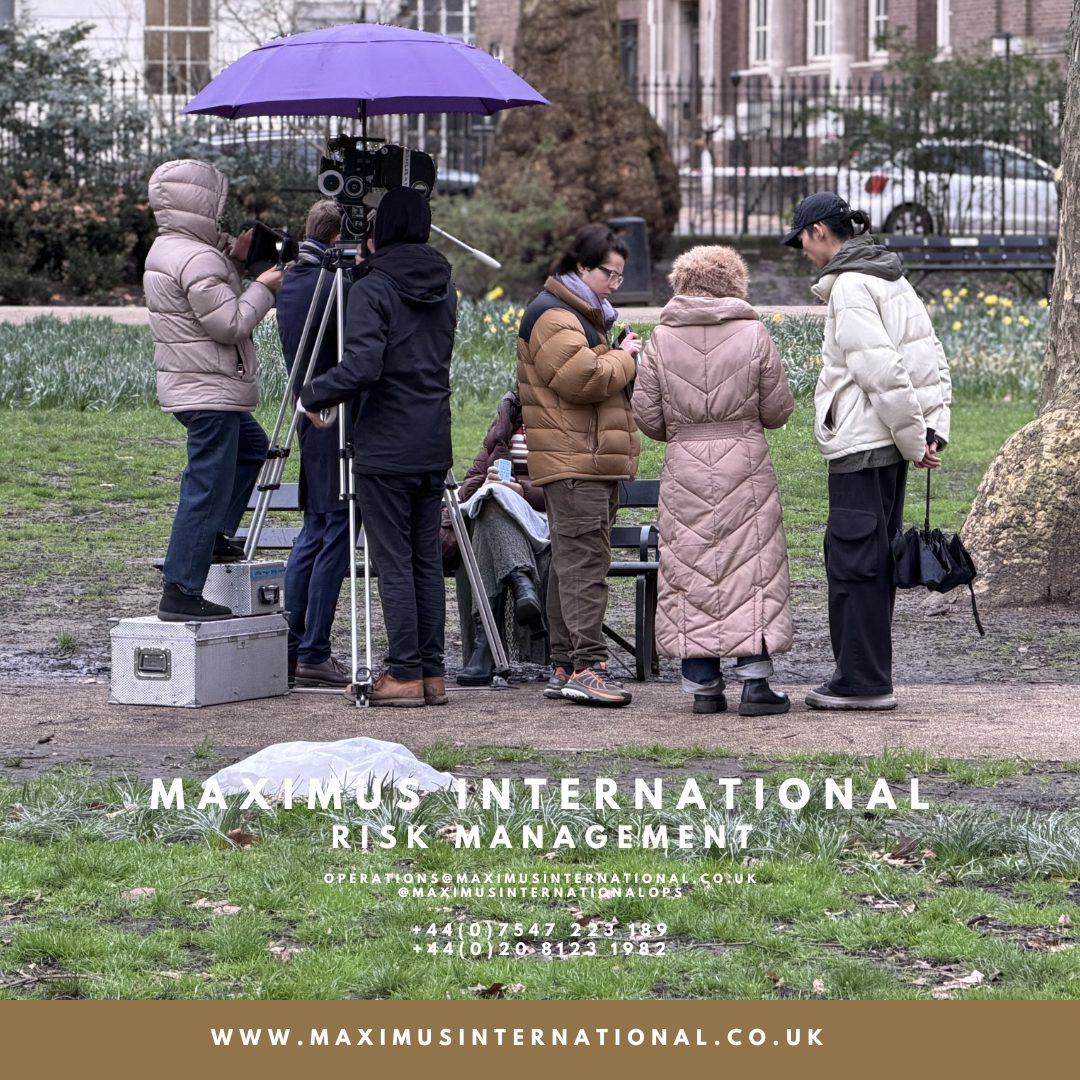
Modern film and television production is increasingly driven by authenticity. Directors, producers and premium content teams are no longer satisfied with environments that feel constructed or overly controlled. They want real streets, real movement, real energy and genuine atmosphere that cannot always be recreated on a soundstage or within a private set.
As a result, more productions are moving into open city centres, transport hubs, hospitality venues, public landmarks and other unrestricted spaces where access remains fluid and public interaction cannot be fully controlled.
These locations undoubtedly enhance the visual quality of a production. They create realism, scale and cultural relevance. Yet they also introduce a level of exposure that many productions continue to underestimate.
For high profile individuals, recognised talent and premium productions, that exposure is even more pronounced.
A filming location does not remain simply a filming location for long. It becomes a point of interest. It attracts curiosity, observation and, increasingly, real time digital amplification. In an era where almost every bystander carries a camera and every moment can be shared instantly, a controlled filming day can become a visible public event within minutes.
This is why risk management and personal security can no longer be treated as secondary support functions. They are now essential components of modern production planning.
There remains a tendency within parts of the industry to assess risk primarily through geography. If filming is taking place in London, Paris, New York or another established Western city, the assumption is often that the environment is non hostile and therefore low risk. By contrast, overseas locations with political instability, elevated crime or a history of unrest are more likely to prompt structured security planning from the outset.
That distinction is no longer sufficient.
Open access environments create vulnerability regardless of whether the broader location is considered hostile. In many so called low risk cities, the issue is not always deliberate aggression. More often, the risk emerges from unpredictability, visibility and the speed at which entirely ordinary public behaviour can become a security problem.
A premium production in a public setting carries all the ingredients required to attract attention. Recognisable talent, branded vehicles, visible crew activity and high value technical equipment create a focal point. Once that focal point is noticed, the surrounding environment begins to change.
Curiosity becomes attention. Attention becomes congregation. Congregation becomes risk.
This shift often happens quietly at first. A passer by pauses to watch. Someone begins filming on a phone. A fan recognises a public figure. A content creator starts broadcasting live from the pavement outside. A small crowd develops. Pedestrian movement slows. Access routes narrow. People move closer. Protective distance disappears.
What may appear harmless in the early stages can change the operational picture very quickly.
For high profile individuals, this is not merely a question of inconvenience. It is a direct personal security consideration. Once a person becomes identifiable, their movements become easier to monitor, their location can be shared in real time and their ability to move discreetly becomes compromised. In the wrong circumstances, the same visibility that serves the production creatively can create personal vulnerability for those involved.
The challenge is compounded by the value of the assets deployed into these environments.
Modern productions frequently carry equipment packages worth hundreds of thousands of pounds. High end cinema cameras, specialist lenses, lighting systems, drones, sound equipment, mobile data units and production vehicles all represent substantial value concentrated within an environment that remains open by design. In a public space, that value is visible not only to genuine observers but also to opportunists actively looking for weakness, distraction or soft targets.
This creates a dual exposure.
On one side is the personal security risk surrounding talent, principals and senior individuals associated with the production. On the other is the asset risk attached to equipment, data, continuity of filming and the broader reputation of the production itself.
If a security issue occurs, the damage is rarely limited to the immediate incident. Theft, interference, accidental damage or aggressive intrusion can stop filming instantly. Delays follow. Insurance issues arise. Confidence is affected. Reputational concerns escalate. What appears to be a small failure in control can have consequences far beyond the event itself.
This is one of the reasons security planning should never begin only when filming starts.
For premium productions, risk management should be embedded into pre production thinking alongside location planning, transport, talent logistics and scheduling. Security is not something that should be added at the edge of the operation or called upon only when a problem becomes visible. It should sit much earlier in the process, shaping how a location is assessed and how filming is executed.
That means looking beyond the aesthetic appeal of a site and asking more practical questions. How does pedestrian flow behave at different times of day. Where are the natural choke points. What are the most likely approach routes. How quickly can talent be extracted if conditions change. Where do vehicles hold. What adjacent premises overlook the location. What lines of sight exist for observation. How likely is real time social media exposure. How will the location function once notable talent is physically present.
These questions are not obstacles to creativity. They are what protect it.
One of the most important elements in this process is continuous situational awareness. Effective security is not simply about having personnel present. It is about having trained professionals who can read an environment, identify behavioural change early and respond before an issue becomes disruptive.
In practice, this means recognising subtle indicators that others may dismiss. An individual repeatedly repositioning to maintain sight of talent. Someone filming more intently than casual interest would suggest. A person appearing at multiple access points. Agitation building within a crowd. Unexpected interest in vehicle movement. Attempts to test proximity or bypass a natural boundary. These are often early indicators of a developing issue.
The value of recognising them early cannot be overstated.
Time is one of the most important advantages during any emerging security concern. The earlier a situation is identified, the more options remain available. Talent can be repositioned discreetly. Equipment can be secured without drama. Vehicles can be moved into place. Routes can be altered. Departures can be accelerated. Access can be tightened. All of this can happen calmly and professionally before the issue becomes visible to the wider crew or public.
The best security interventions are often the least noticeable.
This is particularly important where public image, brand sensitivity and client confidence matter. High profile individuals do not want to feel surrounded by visible tension, nor do productions want security activity to become a spectacle in its own right. The most effective protective teams understand that their role is not to dominate a filming environment but to support it quietly, intelligently and with sound judgement.
This requires more than static guarding. It requires behavioural awareness, discreet positioning, advance planning and the experience to intervene early without creating unnecessary disruption. When carried out properly, security becomes part of the production rhythm. It protects people, assets and continuity while allowing the creative process to continue as intended.
Crowd behaviour remains one of the most underestimated variables in public filming. Crowds are fluid, emotionally responsive and highly influenced by what they believe they can access. A gathering that appears calm can shift character very quickly if expectations change or if talent becomes momentarily reachable. Once a crowd senses proximity, control can deteriorate faster than many production teams anticipate.
Reactive measures rarely provide the same options as early structured control.
This is why risk management at the top end of the industry is not about pessimism. It is about foresight, preservation and value protection. Productions invest heavily in talent, technical capability and location design because each is considered central to the finished result. Security and risk planning deserve the same standard of professional attention.
As filming continues to move further into unrestricted public environments, whether in stable cities or more elevated threat regions, the industry must recognise a simple reality. Personal security, asset protection and structured risk management are no longer peripheral considerations. They are integral to protecting talent, preserving reputation and ensuring production continues without compromise.
When properly integrated, security does not interfere with the creative vision.
It protects the people, assets and production value that make that vision possible.


